Evington Park House – it’s story up to 2026
The Story of Evington Park House: From Ancient Roots to a Potential Community Treasure
Right in the heart of Evington Park stands Evington Park House. Today, visitors know the surrounding park for leafy walks, play areas, cricket matches, and village events. Yet behind its shuttered doors lies a multi-layered story: late 17th-century ceilings, a soldier’s 1830s country estate, a bustling First World War hospital, and the legacy of a civic-minded architect who safeguarded these grounds so the public could enjoy them in perpetuity.
- Before the Burnabys: Romans, Saxons, and Lost Estates
Long before the current house took shape, people lived, farmed, and hunted across these fields:
- Roman Secrets: Ancient Roman communication routes, including the nearby Gartree Road, ran close to Evington, and archaeologists have excavated a substantial Roman villa near Leicester General Hospital. Historians believe the outskirts around Evington served as burial grounds during Roman times.
- The Saxon Village: The name Evington derives from the Anglo-Saxon “Aefa’s ton”—the enclosed farmstead or settlement belonging to a chieftain named Aefa.
- Knights and Medieval Deer Parks: Following the Norman Conquest of 1066, William the Conqueror granted the land to Hugh de Grentesmesnil, who established a deer park here. Over subsequent centuries, celebrated historical figures held the manor and title, including Simon de Montfort and John of Gaunt.
Did You Know? In 1735, physician and botanist Dr. James Sherard purchased the Evington estate after the Duke of Devonshire lost it in a late-night gamble at the card table!
- The Architectural Mystery: An Older House Uncovered
For decades, popular accounts stated that the house was built entirely from scratch in 1836. However, structural and decorative survivals inside tell a much older story:
- 17th-Century Clues: Inside the house, original window features and an ornamental plaster ceiling date back to the late 17th century (late 1600s). This confirms that a substantial home stood here long before the Victorian era—almost certainly throughout Dr. James Sherard’s ownership in the 18th century, if not earlier.
- Colonel John Dick Burnaby’s Redesign (1836): In the 1830s, Colonel John Dick Burnaby (a veteran of the Peninsular War and son of the Rev. Andrew Burnaby) inherited the property through his mother, Anna Edwyn of Baggrave Hall. Rather than erecting a building on an empty field, Colonel John Dick extensively modified, enlarged, and refronted the 17th-century house in 1836 as a retirement home. He also established Home Farm (the brick farmstead buildings that remain visible beside the main car park).
- Victorian Benefactors and the Garden Tea-Drinkings
Following Colonel John Dick’s death in 1852, his unmarried daughters, Miss Henry and Miss Ann Burnaby, lived in the house through to the 1880s:
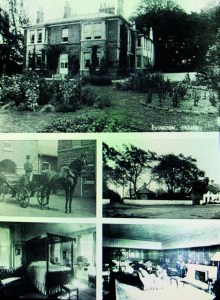
- Victorian Additions: During or immediately following their tenure, newer Victorian sash windows were installed, and sections of the house were expanded.
- Village Generosity: The sisters purchased a harmonium for the village school that their father had built in 1841. They also funded structural renovations, pews, and memorial stained-glass windows in St. Denys Church.
- The Summer Tea-Drinkings: Every summer, Miss Henry and Miss Ann invited the local school children onto the lawns for an annual garden party and “tea-drinking.”
History Detective Clue: In 1997, park visitors uncovered a small carved stone pet memorial hidden in the undergrowth. Its inscribed verse indicates it marked the resting place of one of the Burnaby sisters’ beloved dogs.
- The First World War: Knighton V.A.D. Hospital (1914–1919)
During the First World War, the property was not yet known as Evington Park House—it was called Knighton House. Its owner, John Dearden, offered the house and grounds to the British Red Cross Society as an auxiliary convalescent hospital: Knighton V.A.D. Hospital (Leicestershire / 4).
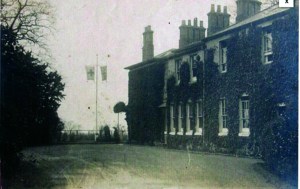

Above: Two perspectives of Knighton House during the Great War. (1) showing a view of the house with the two flags of the Red Cross and St. John’s flying and (2) showing the ivy-covered façade and chimney stacks with the Red Cross flag flying tall beside the approach.
Throughout this period, the primary entrance faced the garden side, looking out across the open lawns. Connected to the 5th Northern General Hospital in Leicester, the home offered recuperating soldiers fresh country air, nutritious food, and quiet surroundings.
Hero of the Home Front: Quartermaster Gwendolen Whittingham
While Commandant Miss Alice Henderson and volunteer helpers from Wyggeston Girls’ School attended to the wards, the day-to-day survival of the hospital rested on its Honorary Quartermaster, Miss Gwendolen (Gwen) Whittingham:
- A Family Dedicated to Duty: Gwen resided at nearby Knighton Grange. Her mother, Alice, helped manage fundraising and hospital supplies, while her brothers served as officers on the front lines of the Somme and Ypres, where the family suffered deep personal bereavement.
- 3,000 Hours of Unpaid Service: Across four-and-a-half years, Miss Whittingham managed the entire logistics chain. She tackled wartime shortages and rationing to secure fresh eggs, milk, vegetables, and meat from surrounding farms, coordinated coal deliveries to keep the large wards warm, and maintained strict audit ledgers for the Joint War Committee and War Office.
- For her relentless dedication, Miss Whittingham was awarded the British Red Cross Society War Service Medal and recorded on the county Roll of Honour.
| Knighton V.A.D. Hospital at a Glance | Details |
| Hospital Facility | Knighton V.A.D. Auxiliary Hospital (Detachment Leicester / 4) |
| Commandant | Miss Alice Henderson |
| Honorary Quartermaster | Miss Gwendolen (Gwen) Whittingham |
| Parent Military Hospital | 5th Northern General Hospital (Base Unit, Leicester) |
| Volunteer Base | Wyggeston Girls’ School staff, former pupils, and local working parties |
| Daily Routine | Porridge, cocoa, and bread at 7:00 AM; lawn games, concerts, and hospital pranks |
- The 1930s: Tom Trevor Sawday’s Transformation
In 1931, the property was acquired by Tom Trevor Sawday (1879–1964), an accomplished Leicester architect and aviation pioneer.
Sawday came from an eminent local architectural family:
- Civic Connections: His father, Albert Edwin Sawday, was Mayor of Leicester in 1903 and designed “The Y” (YMCA) on East Street. Trevor also married into the family of Arthur Wakerley, the civic leader who planned North Evington.
- Architectural Works: Trevor Sawday was the architect behind major regional landmarks, including the original Granby Halls (1915) and Leicester’s landmark Central Fire Station on Lancaster Road (1927). A passionate aviator, he also co-founded the Leicestershire Aero Club at Desford.
- Remodelling the House: Sawday adapted the layout into an interwar country home. Most importantly, he reoriented the building by constructing the formal main entrance used today, while preserving the original garden-side doors. He also added the bright loggia (now known as the Sun Lounge room) along the garden elevation.
- World War II: Home Guard HQ, Air Raids, and Unexploded Bombs
During the Second World War, the residence served as operational headquarters for the Evington Home Guard Platoon, with Captain Tom Trevor Sawday serving as second-in-command. The property survived two direct wartime incidents:
- 20 November 1940: A stick of high-explosive bombs fell across the village, blasting a crater where the park’s cricket pitch is situated today.
- 10 April 1941: A damaged twin-engine bomber clipped a chimney stack along St. Denys Road and crashed into the entrance drive (now Cordery Road).
Bombs in the Loft! Following the air raid damage, an inspection of the roof revealed two unexploded bombs lying side-by-side in the attic rafters. Mrs. Sawday and her maid were evacuated while military disposal teams rendered the munitions safe.
- Securing Evington Park (1947) and Today’s Crossroads
In 1947, Tom Trevor Sawday agreed to sell the house and its surrounding grounds to the Leicester Corporation at a generous price. In keeping with the civic ethos of the Sawday and Wakerley families, he placed an enduring legal covenant on the title:
“The land must never be built upon, but shall be preserved for the enjoyment of local people in perpetuity.”
Following this public purchase, the property was formally named Evington Park House, and the grounds opened in 1948 as a municipal public park with village celebrations.
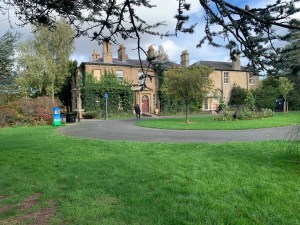
Above: Evington Park House as it stands today—a valuable heritage asset currently closed and shuttered, awaiting its next chapter of community renewal.
A Heritage Treasure Awaiting Its Future
From the 1970s onwards, the upper floor provided a flat and offices for the Park Ranger and Park Services, while ground-floor spaces (the Oak, Beech, and Panel rooms, alongside the Sun Lounge) served community gatherings.
In late 2023, council and community uses ceased, leaving the house closed. Local voluntary groups led by Helen Pettman (Friends of Evington) and Raj Sharma (Chair of Best Community Charity) have worked through complex leasehold negotiations, structural surveys, and safety assessments with Leicester City Council. Their goal is to safeguard the historic building without placing an unsustainable burden on charity trustees, working toward an arrangement that balances commercial sustainability with open community access.
Evington Park House stands today as a potential treasure—a building with over three centuries of history, from early gentry origins and wartime relief to municipal sanctuary, waiting for its next chapter to begin.
Quick Family Fact: A Royal Connection!
The Burnaby family of Evington shares a direct link with the British Royal Family:
- Colonel John Dick Burnaby’s niece, Caroline Louisa Burnaby (1832–1918), married the Rev. Henry Cavendish-Bentinck.
- Their daughter, Cecilia Nina, became the Countess of Strathmore.
- Cecilia’s daughter was Lady Elizabeth Bowes-Lyon—who became Queen Elizabeth The Queen Mother (mother of Queen Elizabeth II and great-grandmother to King Charles III).

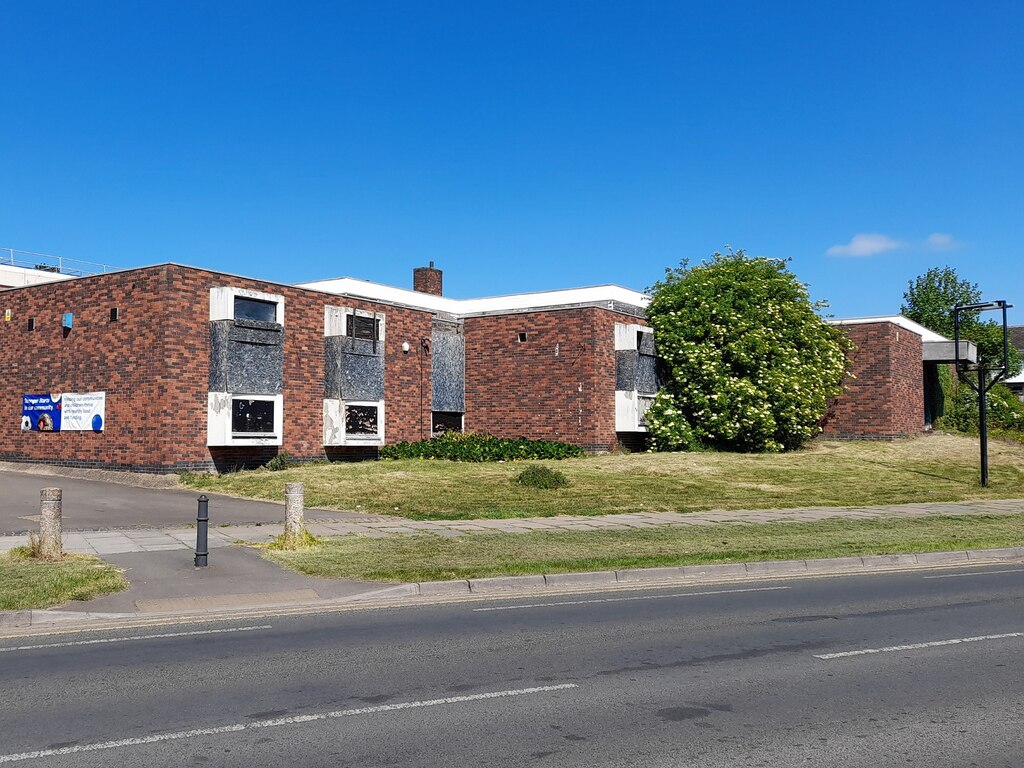




What are the next moves to secure Evington Park House and maintain Tom Trevor Sawday’s 1947 enduring legal covenant on the title wich states:
“The land must never be built upon, but shall be preserved for the enjoyment of local people in perpetuity.”