Better Together-Understanding the 2022 Violence in Leicester
[Image: 5Pillars]
A report by the Independent Commission of Inquiry into the 2022 Leicester violence, published by the School of Oriental and African Studies, London, in February 2026 examines in some detail the political, geopolitical, social and economic factors that led to unprecedented violence on the streets of Leicester. This is a comprehensive report covering many complicated facets of these most disturbing recent events. In this short summary a few of the salient points are raised.
The report sets the context of the disorder which it says emerged in a volatile and divided environment where migrant and Muslim communities faced hostility, with the rise of far-right parties and ideas with a presence not seen since the 1970s. The violence towards migrants had become a repeated characteristic of far-right activities. Local tensions are said to have been further massaged by international events, including tensions between India and Pakistan.
Among the report’s findings it is concluded that a focus on celebrating diversity by way of individual festivals took place rather than working on encouraging better integration which then led to communities coexisting rather than interacting in any meaningful way. In addition, communities were largely ghettoized and only insignificant contact was prevalent across housing, schools, and daily life, despite the city politicians trumpeting a public image of racial harmony.
The gradual phasing out of secular spaces shared by different community groups and a decrease of programmes designed to promote integration led to further segregation, especially within younger age groups. The loss of secular facilities such as youth centres and other community services reduced prospects for multicultural friendships and mixing, while the rise in supremacy of religious amenities further entrenched communal identities.
The City Council is seen as having failed in several key areas as their strategies became more and more outdated and not fit to manage the changes in the nature of the population .
“The city council has historically maintained separate relationships with Hindu, Muslim and other religious groups rather than fostering collaboration among them.” (Page 18).
The City Council and particularly the Mayor, Sir Peter Soulsby, come in for direct and hard-hitting criticism.
The City Council’s failed crisis leadership and out-dated multi-ethnic and community influencing structures did not help to calm mounting pressures and got in the way of a managed political response that was needed to tackle the violence and undermined any faith people had in them.
“The Inquiry found no evidence of leadership from the mayor or city council during and after the violence. Police spokespeople often took lead roles in community engagement while the mayor offered little visible leadership.” (Page 13)
Also, there was no political forum for councillors to meet across party or faith groups to examine the unrest. Frightened residents had little support other than through individual interventions by councillors.
“We found extensive, engaged and responsive actions, often amid challenging and dangerous situations, by several councillors (Labour and Conservative) acting independently and on their own initiative to calm the situation and assist those being attacked, threatened, or held by the police.” (Page 13)
There was a dismal attempt to bring about reconciliation following the unrest. No meaningful community meetings followed the violence, despite being sorely needed. This allowed polarising narratives to fill the vacuum.
Evington is highlighted in the report along with Spinney Hill Road as areas that have maintained a highly mixed population profile even following the segregation of communities into specific housing areas from the 1970s onward.
“Housing segregation in Leicester emerged in the 1970s, with Hindus more concentrated in Belgrave, Rushey Mead, and Abbey, and Muslims in Spinney Hill, Highfields and St Matthews. Nonetheless, many areas – such as Evington and Spinney Hill Road – remain highly mixed, contrary to some perceptions. Wealthier Asians, particularly East African Hindus, have moved to Oadby and other suburban areas around the city. Both economic class and religion play intertwined roles in shaping these patterns of segregation.” (Page 20)
Leicestershire Police also faced criticism in the report, including criticism over poor monitoring of people mobilising on social media, a perceived inequality in the treatment of Hindu and Muslim men, and a general lack of understanding of communalism.
The report blamed neither the Hindu or Muslim community for its role in the disorder which broke out over the summer of 2022, saying that “no group was solely responsible” for the violence and that members of Hindu and Muslim communities were “both victims and perpetrators”.
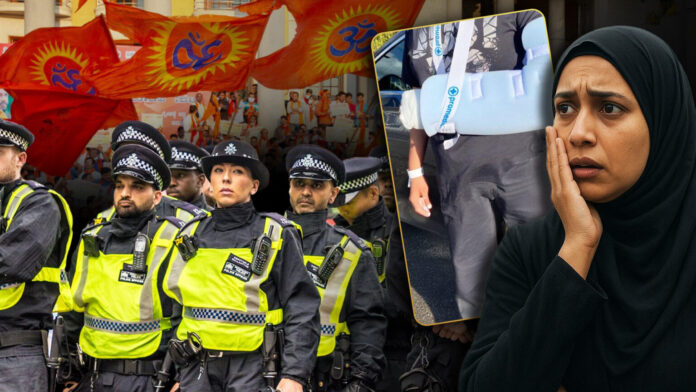
It does raise however concerns over Hindu nationalism (Hindutva) among some members of newly arrived, largely Hindu Daman and Diu communities which is viewed as a clear factor in the 17 September march and subsequent disorder. This also took on an international dimension.
The report covers many other aspects of the political, social, economic and cultural landscape, prior to the unrest, during it and following it. It appears to be a thorough and thoughtful inquiry into these profoundly disturbing events, however there is a failure to consider the effect of the gradual dilution of the white British population in the City of Leicester and the possible tensions and rivalries filling this vacuum might have caused.
Finally, the report makes eighty recommendations covering politics, policing, community relations and socioeconomics and one wonders just how practical it will be to accept them all and implement them.
Source:
1-Bhatt, C et al (2026) Better Together-Understanding the 2022 Violence in Leicester. A report by the Independent Commission of Inquiry into the 2022 Leicester violence, School of Oriental and African Studies, London.
2-https://evingtonecho.uk/better-together-2026-understanding-the-2022-violence-in-leicester/
3-https://www.leicestermercury.co.uk/news/leicester-news/police-sir-peter-soulsby-could-10831624