‘Money Talks’ What Rango’s Wombly Walkies is finding in Evington – and how we can all help
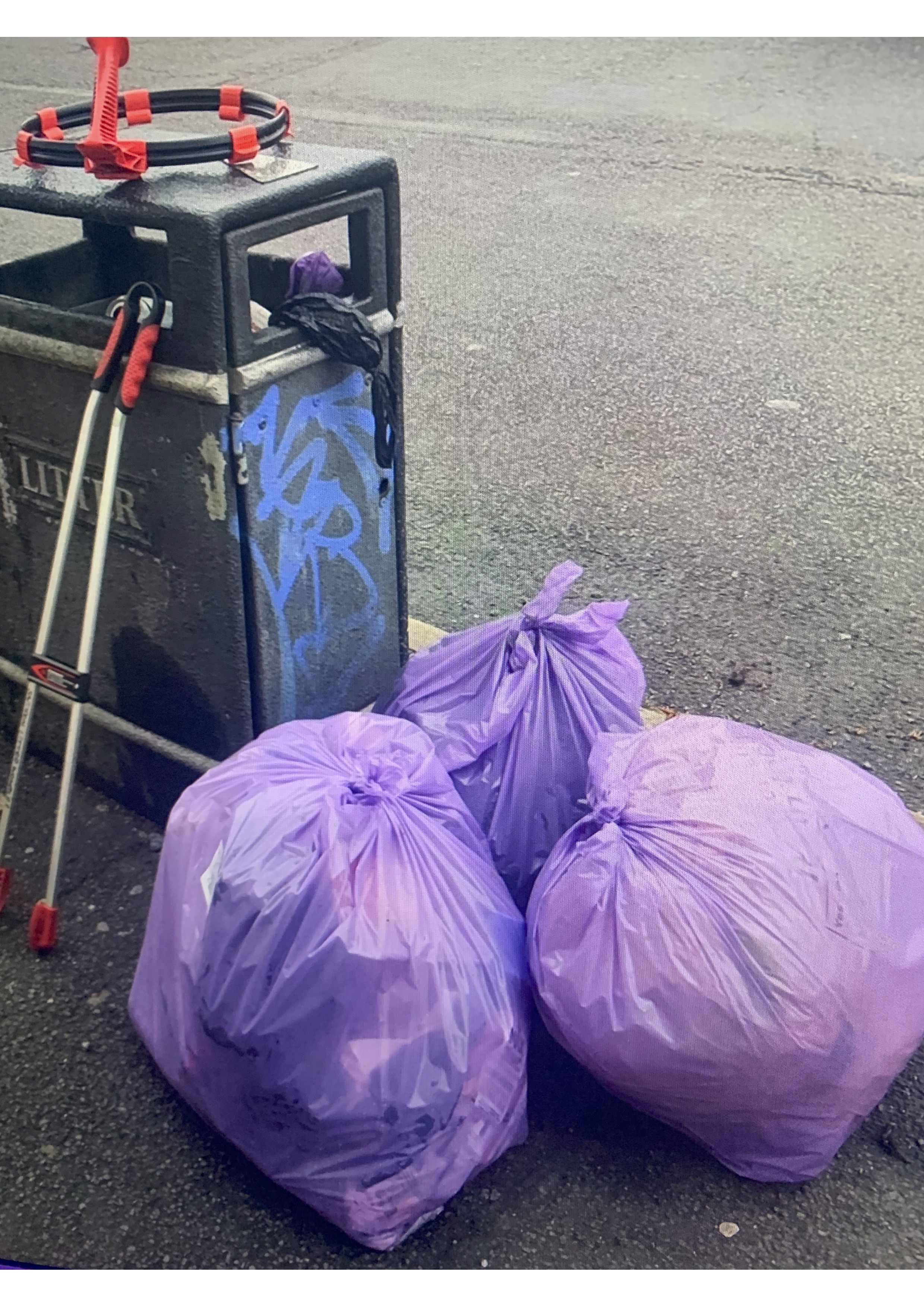
Evington is lucky to have residents who look after our neighbourhood simply because they care. Many people take a litter picking stick on their regular walks. The local “Litter Wombles” tradition—affectionately named after The Wombles of Wimbledon—has inspired groups across the UK, and in our area we’re supported by the wider Wombles community as well as local teams and individuals.
One of those individuals is Rango’s Wombly Walkies: a familiar sight out and about every day with his dog, Rango, doing litter picks, taking photos, and reporting issues that need a Council response. It’s practical, persistent, and it makes a real difference—especially because it doesn’t just tidy up, it also helps identify where problems keep happening.
Recently, Rango’s Wombly Walkies posted the following on Facebook:
“If you want to use our car parks for a race track, deal drugs and dump all your takeaway cartons and spent nitrous canisters, then you pay the price. Money talk, money talks. Dirty cash, I want you. Dirty cash I need you. Oh, Oh, Oh, Ohhhh.”
Some readers asked: what does it mean? Here’s a friendly, plain-English explanation—and why it matters for Evington.
What he’s talking about (in everyday terms)
1) Car parks being used like ‘race tracks’
When residents say a car park is being used as a ‘race track,’ they usually mean antisocial driving: speeding in circles, revving engines, wheel-spins, loud exhausts, and late-night gatherings. Even when nobody is physically hurt, it can still make people feel uncomfortable using the space—and it can bring extra litter and damage with it.
2) Worrying behaviour that looks like dealing
The second line—about drug dealing—is serious. Volunteers and residents aren’t there to investigate, accuse people, or put themselves at risk. But regular walkers and litter pickers can notice patterns: cars arriving briefly and leaving quickly, repeated visits at unusual times, and groups gathering in the same corners.
The key point here is safety: don’t confront anyone. If something feels wrong, step away and report it through the right channels.
3) The ‘evidence on the ground’: takeaways and nitrous canisters
The third part is the most visible: the rubbish.
- Takeaway cartons, cups, wrappers and bags are a constant frustration—especially when they’re dumped right next to bins or tossed out of car windows.
- Spent nitrous oxide canisters (sometimes called ‘nitrous’, ‘NOS’ or ‘laughing gas’ canisters) are another type of litter that many areas are now seeing more often. They’re unpleasant to look at, can be sharp, and can be dangerous for pets and wildlife.
When the same kinds of litter keep appearing in the same types of places, it suggests those spots are being used for late-night hangouts—followed by dumping. One local example Rango has mentioned in the past is Shady Lane Car Park by the Arboretum, but his point is wider: it’s happening across Evington and Leicester not just in one location.
‘Money talks’ : why he quotes a song
The ‘Money talk, money talks… Dirty cash…’ line is a reference to a well-known dance track (Dirty Cash (Money Talks)). Rango’s Wombly Walkies is using the lyrics to make a point: sometimes the only thing that changes behaviour is real consequences.
In practice, ‘money talks’ can mean:
- fines or enforcement action where evidence allows,
- cleanup costs that come out of public budgets,
- extra resources directed to hotspots (signage, lighting, targeted attention) after repeated reports.
It’s not about being dramatic—it’s about saying: Evington shouldn’t have to keep paying the price for a small minority treating shared spaces like a dumping ground.
The positive part: what Evington is already doing
The encouraging side of this story is that the clean-up work is happening—and it’s consistent.
When someone like Rango’s Wombly Walkies is out daily, it creates:
- quick improvements (litter removed before it spreads),
- a record of repeat problems (photos and dates),
- better reporting (so the Council can respond to what residents can’t safely or reasonably remove).
This is how a community gradually turns the tide: not just by picking up, but by logging patterns so they can be tackled properly.
What we can all do next (without putting ourselves at risk)
1) Don’t confront—report instead
If you come across risky behaviour or feel unsafe:
- leave the area,
- don’t engage,
- report using the correct official route for urgent concerns.
2) Use Love Clean Streets so it’s logged (not just grumbled about)
A photo and a pinned location can be the difference between ‘someone told us once’ and ‘we can see a repeat hotspot and respond properly.’
How to use Love Clean Streets
Step 1 — Download the app
Search ‘Love Clean Streets’ in your phone’s app store, install it, and open it. If prompted, allow location access so it can place the pin accurately.
Step 2 — Pick the issue type
Choose the closest category (for example):
- Litter
- Overflowing bin
- Fly-tipping (dumped bags/items)
- Dog fouling
- Graffiti
Step 3 — Pin the exact location
If you’re on the spot, the app usually uses your GPS. Otherwise, zoom in and drop the pin precisely (e.g., “car park entrance,” ‘by the bin,’ ‘far corner near the hedge’). The more accurate, the quicker it can be found.
Step 4 — Add a photo (only if safe)
A clear photo helps the Council assess what’s needed and which team should attend. Try to include a landmark (a bin, sign, gate) so it’s easy to locate.
Step 5 — Write one helpful sentence
Examples:
- ‘Two full bags left beside the bin—too heavy to move.’
- ‘Takeaway waste scattered across bays; keeps reappearing.’
- ‘Several nitrous canisters on ground near parking spaces.’
Step 6 — Submit and keep the reference
After submitting, the app normally stores the report in your history or gives a reference number. Keep it for follow-up if needed.
Step 7 — If it’s dangerous, don’t rely on the app alone
If there’s immediate danger (for example, something hazardous that needs urgent attention), use the appropriate urgent reporting route as well.