A Walk around Piggy’s Hollow (21st July 2026) – with Peter Liddle and Chris Hossack
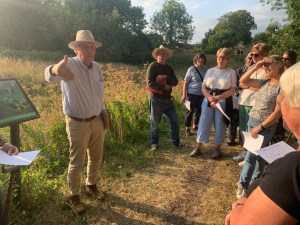
One of the most valuable parts of the walk was Peter’s clarity about what he knows, how he knows it, and what he doesn’t know. That mattered because, as he explained, not everything we would like to know—especially about the ownership of individual fields in medieval times—was written down in records that survive today. Even interpretation boards can only go so far, because some details inevitably involve informed conjecture.
Peter told us that the earliest map he has found so far is dated 1627, from the archives at Chatsworth House. On that map, features we might expect to be central to a parish—such as the church and manorial focus—appear to sit in the eastern corner of the parish, which is unusual. Peter said he didn’t yet know why Evington’s layout is like this. One possible explanation, he suggested, is that parish boundaries may have been established much earlier and that the “centre” of activity in earlier times could have related to the area around Crown Hills, where there is evidence of an Iron Age settlement and a Roman villa. Was there a parish here since Roman times? It’s an intriguing question—and at present, a question rather than a conclusion.
Peter then took us through what the documentary record does show. The Domesday Book (11th century) includes an entry for Evington. After the Norman Conquest, the land is recorded as belonging to Hugh de Grandmesnil, a powerful Norman lord. Domesday notes land for plough teams, meadow, and a mill—evidence of a working agricultural landscape with managed resources.
Later records indicate the development of the medieval manorial centre. Peter explained that stone and ridge tiles have been found on the site, and these help date the manor house here to the 13th century. He described how records show the manor house (near St Denys Church) was associated with the de Grey family, who held the site for around 200 years.
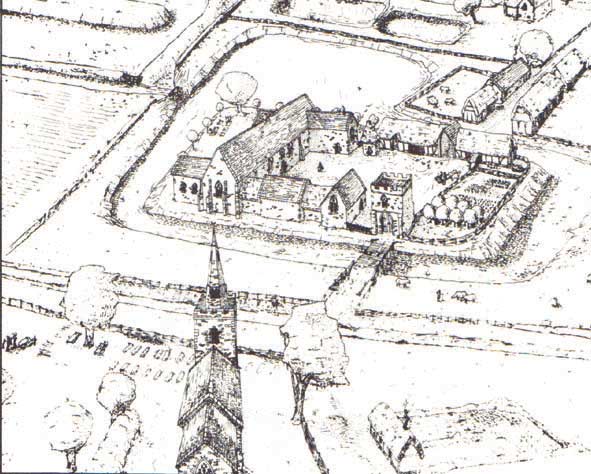
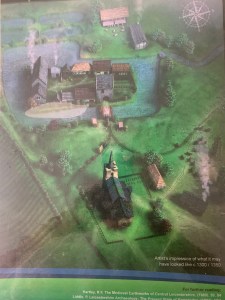
We started the walk at St Denys Church. Nearby, we noted a modern house where there is a mud wall visible inside, typical of medieval construction for poorer people—an immediate reminder that the medieval story here includes both the powerful and the less powerful. From the churchyard we looked at the illustration of how we guess the site may once have looked, and Peter asked us to imagine the moat as it probably was: much deeper, before centuries of silting reduced its depth.
A big question, of course, is why a moat? Peter was careful not to over-claim. We don’t know a single definitive reason. It may have been a status symbol, it may have helped deter theft if deep enough, and the water would certainly have been useful for gardens and domestic purposes, including cleaning.
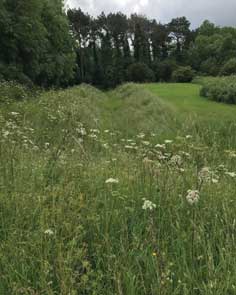
Walking anticlockwise around the site we came to a large patch of brambles, which unfortunately blocks the view across to where Peter identified fish ponds. This is also where Peter said he believed a drawbridge would have given access onto the platform—what he called the central area surrounded by the moat.
Chris then brought the site into the present, talking about wildlife and ecology: badgers (whose digging can sometimes unearth stones), muntjac deer, and buzzards overhead. It was a helpful reminder that Piggy’s Hollow is not only a heritage place but also a living habitat, and that future care needs to respect both.
Peter also touched on later owners and stories associated with the land, including the Duke of Devonshire, the Cavendish family, and William Stanley (noted for his role at the Battle of Bosworth). When the 1627 map was made, Peter told us the area we now call Piggy’s Hollow was labelled “Hall Yard.”
As we walked along a line that would once have been part of the moat, we looked at the earthworks and Peter explained how sluice gates would have helped control water levels. He also placed the site in its wider social context. Peter said it is certain that the first half of the 14th century was one of the worst times to be a peasant: repeated hardship, disease, and heavy demands of labour and tax. Later in the 14th century, fewer workers meant some peasants could demand better terms.
A particularly revealing documentary moment comes from 1308, when Henry de Grey died and an audit of his Evington estate was made for taxation. Peter described how this audit lists a manor house, gardens, an enclosed courtyard, arable and meadow land, restricted pasture, and a complex water system including a water mill and a windmill.
Finally, Chris explained the name ‘Piggy’s Hollow’ itself. It is not medieval: it comes from Victorian times. A local farmer let pigs graze here and, Peter told us, smeared the moat sides with manure to deter children from playing there. The farmer was nicknamed ‘Piggy Wilson,’ and his farmhouse still survives on Church Road.
This walk felt like the beginning of a much bigger local story—one that is fascinating precisely because it includes both what we can prove and what we still don’t know. We’ll be sharing more in future posts.